Not all Atlantic salmon grow the same. Even when two fish of the same age are reared in the same tank, under the same water conditions, they can still grow differently. One may grow faster, use its feed better, and contain more omega-3 fats than the other. So, where does the difference come from? For many years, farmers believed it was due to the fish’s genes and the environment in which it was reared. That means fish with good genes result in better performance. Today, we know that genes are only part of the story. There are trillions of tiny microorganisms living inside every salmon. These microbes may influence how well the fish grows, how efficiently it uses its feed, and even how much omega-3 fat ends up on your dinner plate. My PhD research focuses on Atlantic salmon, one of the world’s most important farmed fish. I study how the gut microbiome influences feed use and omega-3 fat content, and how it interacts with the fish’s genes to contribute to these important traits.
Two challenges we aim to solve
Feed is the biggest cost in salmon farming. In Norway, the world’s largest producer of Atlantic salmon, feed accounts for about 70% of production costs. Even a small improvement in how efficiently salmon converts the food they eat into body weight and growth saves money. It also reduces the resources needed to produce healthy fish. The second challenge is maintaining the nutritional value of farmed salmon. Salmon are famous for being rich in healthy omega-3 fats. These fats, especially EPA and DHA, are important for heart, eye, and brain health. In the past, salmon feed contained large amounts of fish oil, a natural source of these fats. Today, fish oil is more expensive and more difficult to source sustainably in quantities large enough to feed millions of salmon. As a result, farmers use more plant-based ingredients, like vegetable protein and vegetable oils, in salmon feed instead. This change is better for protecting wild fish stocks. However, plant ingredients contain much less EPA and DHA than fish oil. As a result, farmed salmon get less of these important fats. This can reduce the amount of omega-3 in their fillets. This raises an important question: can we breed salmon that grows well on more sustainable feeds while still producing healthy, nutritious fish? My research explores whether part of the answer lies not only in the salmon’s genes, but also in the billions of tiny microbes living in its gut. I want to identify which gut microbes are related to better feed use and higher omega-3 content and understand how much of the variation in these microbes is controlled by the salmon’s genes.
Meet the secret world inside the salmon gut
Inside the gut of every Atlantic salmon lives a large community of tiny organisms called the gut microbiome. This community is made of bacteria, fungi, viruses, and archaea. They are so small that millions could fit on the full stop at the end of this sentence. Think of the gut microbiome as a busy city living inside every fish, with its own workers, systems, and clear communication networks. Some microbes help break down food that the salmon cannot digest on its own. Others produce useful substances, support the immune system, and help protect the fish from harmful microbes. The fish and its microbes work as a team. When a salmon eats, the microbes help process the food and influence how the nutrients are used by the body. The gut microbiome is not just something that lives inside the fish. It is an important part of how the fish functions.
Genes, gut microbes, and the hologenome
Every salmon is hatched with its own set of genes. Genes are pieces of DNA that act like an instruction manual. They tell the fish how to grow, develop, and direct their function. Some fish inherit gene combinations that help them grow better or use feed more efficiently. For a
salmon to grow, it must digest its food, absorb nutrients, and turn them into new body tissue. How well this growth process happens depends on the fish’s genes, the microbes living in its gut, and the environment, such as its feed and the tank in which it is reared. Together, these shape the fish’s phenotypes. These are the measurable features of salmon we can record, such as the growth rate, feed use, omega-3 content, and fillet yield. But genes do more than shape the fish performance alone. They also influence the community of microbes living in the gut. Genetic differences between individual fish affect which microbes can live in the intestine. As a result, two salmon reared under the same conditions can still have different gut microbiomes. Together, the salmon and its gut microbes form a biological unit called a holobiont. Their combined genetic information, that is the salmon’s genome and the genomes of its gut microbes, is called the hologenome. The hologenome concept means that these genomes work together to influence traits. Hologenomics is the science of studying these interactions. Because both the fish’s genes and its gut microbiome contribute to a trait, we can divide the differences we see between fish into two parts. The share explained by the fish’s genes is called genomic heritability (h²). The other share due to the gut microbiome is called microbiability (m²). Understanding how much of a trait, such as feed efficiency or omega-3 content, is explained by h² and m² is what my project is all about. It will help us understand whether we should breed for the fish’s genes, its gut microbiome, or both.
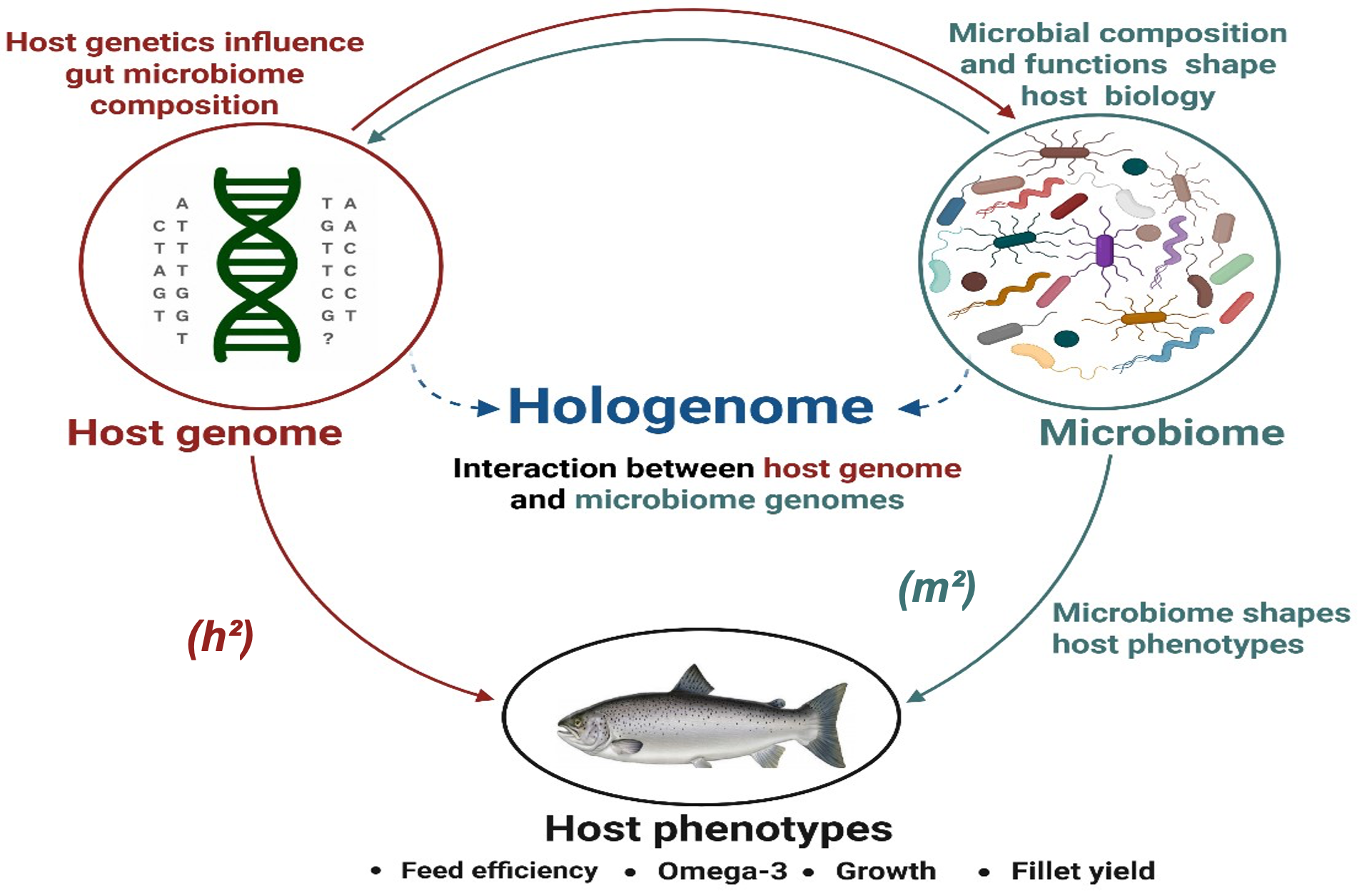
Figure 1. The hologenome concept. The salmon’s genes influence its gut microbiome, and the gut microbiome, in turn, influences important traits such as growth, feed efficiency, omega-3 content, and fillet yield.
The half of the picture we have been missing
Traditional salmon breeding has been very successful. Breeders measure traits such as growth rate and feed efficiency in thousands of fish, select those with the best genes, and breed them together. This has really improved salmon production. But one important piece has often been overlooked: the community of microbes living inside the fish’s gut. Think of it as judging a moving car by looking only at the engine while ignoring the fuel and the tires. I aim to close that gap by using the hologenome concept to figure out how much of a trait comes from the fish’s genes, and how much comes from its gut microbes. So far, our early results suggest that some gut microbes are partly controlled by the salmon’s genes. If we can identify the microbes linked to better feed use or higher omega-3 content, they could potentially become a new target for breeding Atlantic salmon. Not just the genes, but the microbes as well.
What happens when a salmon goes to sea
One clue that genes do shape the gut microbiome comes from watching what happens as a salmon’s environments change, like when it moves to sea. Atlantic salmon begin their life in freshwater before moving to the saltwater phase. During this transition, their bodies go through big changes to adapt to life in saltwater. Their gut microbiome changes too. Some bacteria disappear, while new ones become common. At first, this looks like a complete change. But something important happens. Although the types of bacteria change, the jobs they do stay much the same. They continue to help digest food, support the immune system, and help the fish absorb nutrients. This suggests that salmon do not simply carry random microbes. Instead, they may help choose microbes that do the jobs they need.
What the research looks like
To test ideas like this properly, my research follows a clear set of steps, from live fish all the way to data on a computer. That is combining fieldwork, DNA testing, and data analysis to understand how genes and gut microbiome affect how well salmon perform. It starts with 846 Atlantic salmon from 30 families (Figure 2A). The fish were reared in tanks (Figure 2B).
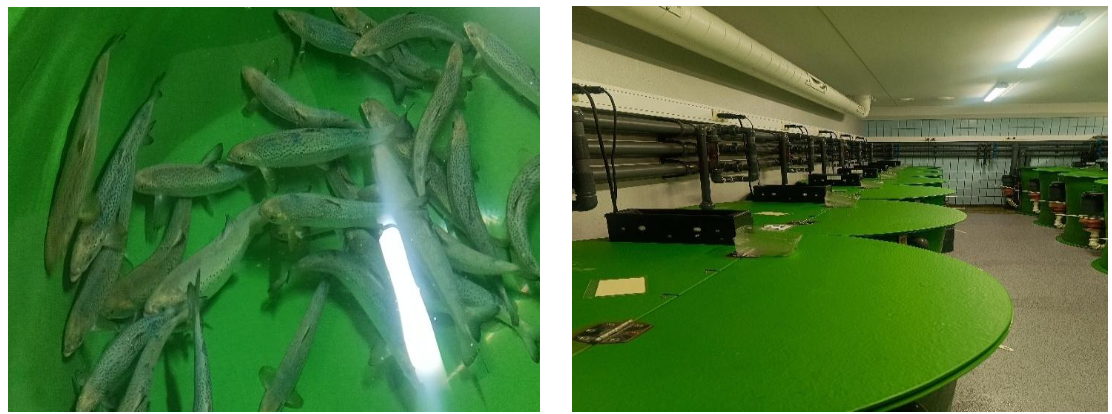
Figure 2. A. Atlantic salmon. B. Production tanks, where fish were reared.
Once the fish are fully grown, we open them up and collect digesta, the material inside their distal gut (Figure 3A). Back in the lab, we prepare and store these gut samples (Figure 3B and C). Then we pull out the DNA of the bacteria living inside them and check that the DNA extracted from the gut microbes is of good quality (Figure 3D). We then use a method that reads a specific, recognizable piece of bacterial DNA. This method is called 16S rRNA amplicon sequencing. It reads a specific region of bacterial DNA that acts like a barcode on a product to figure out exactly which bacteria are present in each fish’s gut.
Also, we know the genetic information of all fish, and we measured the body weight and length of each fish, how well each fish used the feed it consumed, and how much omega-3 fat it contained, both while it lived in freshwater and later in saltwater. Finally, we combine everything, genetics, gut bacteria, and physical measurements, using statistical models. These models enable us to estimate how much of the differences between fish come from their genes, their environment, and their gut microbiome.
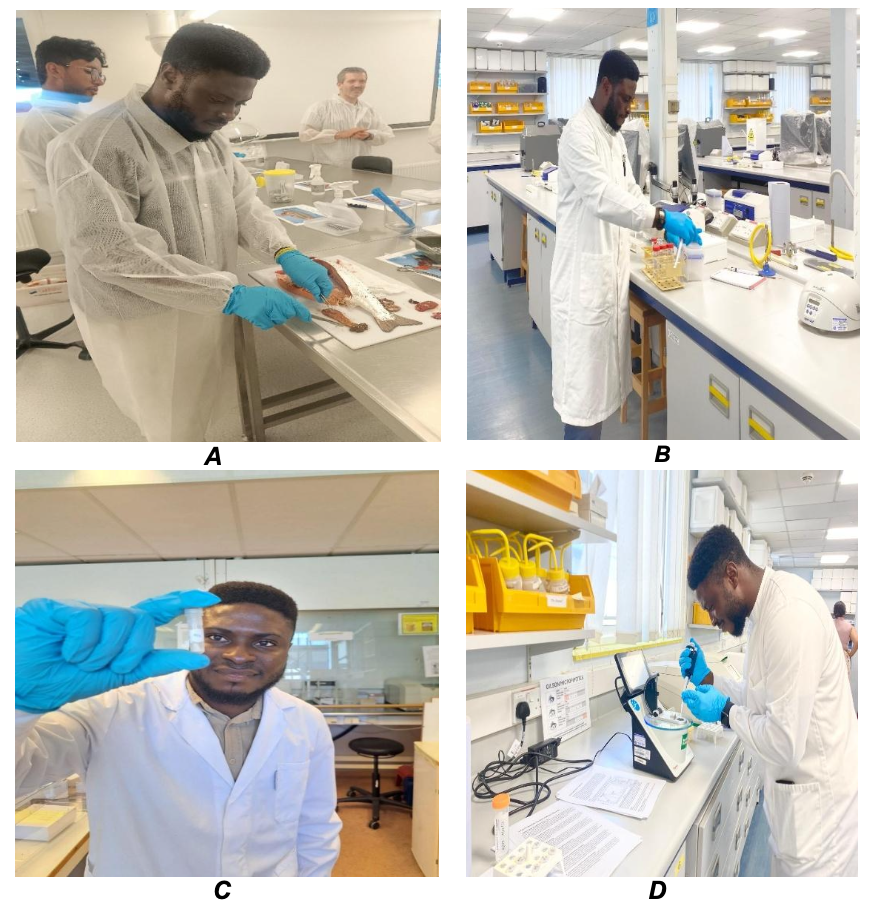
Figure 3. (A) Dissecting Atlantic salmon to harvest gut samples (digesta) for microbiome analysis. (B) Preparing gut microbial samples. (C) A preserved gut digesta sample for genomic microbial DNA extraction. (D) Checking the amount and quality of DNA from the gut microbes before 16S rRNA amplicon sequencing.
What excites me most
Working through this process is where the excitement of the project really comes alive. For decades, animal breeding has focused almost entirely on genes. Then I try to understand whether there is another important player that has been there all along. If some gut microbes are partly controlled by the salmon’s genes, and they also affect feed use and omega-3 content, then genes alone cannot explain why some fish perform better than others. We have only been reading half the story. The other half was there all along, hidden inside the gut. What makes this even more exciting is that we are testing these ideas using real data, from salmon raised under real farming conditions.
A small community, big question
A salmon’s genes and its gut microbiome shape each other, and together they influence how the fish grows, uses its feed, and stores omega-3. The environment where they were reared and the feed they consume influence them. Together, they form a biological system that we are only beginning to understand. Can we breed salmon with a gut microbiome that supports healthier and more sustainable production? I believe we can. Understanding how genes and gut microbes work together, we may be able to produce fish with better omega-3 content and use feed more efficiently. One day, salmon farmers may ask not only, “Does this fish have beneficial genes?” but also, “Does it carry the right gut microbes?” That shift could change how we breed fish and help make fish farming more sustainable.
