What can newt poop teach us about how animals respond to climate change?
On the surface it sounds like a ridiculous question, but that is what I am trying to address in my PhD project. I’m Elsa, a PhD student at the University of Copenhagen, where I am investigating how bacteria living in the gut of newts may (or may not) impact their ability to adapt to climate change.
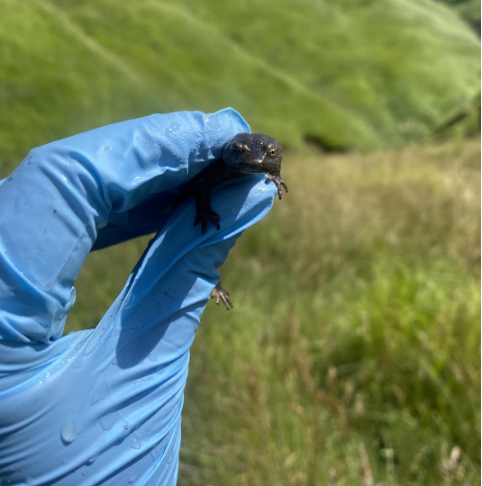
Pyrenees brook newt (Calotriton asper), captured during fieldwork in July 2025.
First, we need to reframe our point of reference
When we think of animal adaptation, we think of things like thick fur, to help polar bears stay warm in cold climates, or good eyesight, to help owls hunt at night. But when we stick to this traditional definition of adaptation, where phenotypic (physical) traits are adjusted to better suit the environment, we may be missing an important layer of complexity. Every animal can instead be thought of as both an animal “host” and all of the microorganisms living on or within it. More concisely, a holobiont.
This concept of a holobiont may be more familiar than you think. Consider for instance coral reefs. You may have heard before that corals are actually a partnership between the coral-animal (here, our host) and photosynthetic micro-algeas. The coral cannot exist healthily without its algaes, and when we say “coral,” we often actually mean both the coral and its associated algaes— a holobiont!
You may also have heard that lichens, the organisms that grow on rocks and tree trunks, are not just fungi, but actually a symbiosis between fungi and micro-algae that need each other to exist. Yet we consider them jointly, as just “lichen,” one unit, one holobiont.
We can apply this same concept to more complex systems as well. Maybe you have heard that you should eat yogurt to maintain a healthy “gut microbiome,” the community of microorganisms living in the intestinal tract of humans. You too are a host for a diverse and complex community of microbes living everywhere in and on your body— from your intestines, to your skin, we are constantly interacting with microbes. In this case, you are the host. Considered jointly with your microbes, you are a human holobiont.
We can think about almost every organism in this way. And it’s necessary to do so, if we want to truly understand the dynamics of how animals adapt and interact with their environment.
Within a holobiont system, the host provides a hospitable environment for its microbes, and the microbes in some cases may provide services that benefit the host. In our examples above, the micro-algaes in corals and lichens photosynthesize, making nutrients for the host. Similarly, the bacteria in a healthy human gut microbiome can provide a variety of functions to improve your digestion (among many other valuable functions).
But what does this have to do with adaptation?
Bacterial communities are incredibly dynamic and have much shorter lifespans than their hosts. This means that, comparatively to their hosts, bacterial communities can adapt much faster to changing environmental conditions.
Imagine you are sick, and you are prescribed a short course of antibiotics. These antibiotics will diminish many of the bacteria living in your gut microbiome, and after you are finished with the treatment, your gut will then recover. In what feels to you like a very short window of time (only two or three weeks), you will be back to “normal.”
If you shift your perspective, and think instead from the point of view of your gut, this same window of time looks very different. Multiple generations of bacteria will come and go. The entire ecosystem will be dramatically changed and restructured. The whole time, each new generation of bacteria is adapting to the environmental conditions present.
Simply put: bacteria reproduce much faster than their animal hosts, and can therefore react faster to environmental change. These reactions may provide different and perhaps even beneficial functions to the host, who cannot adapt so rapidly.
And that brings us back to the newt poop.
Amphibians around the world are in decline, primarily due to rising temperatures and decreasing water availability caused by climate change. Newts are particularly at risk. On an evolutionary timescale, newts who are better adapted to these warmer and drier conditions will survive. However, evolution through genetic change takes many generations, and the newts may not have time to adapt in this way.
But remember, the newt is not just a newt. Newts are holobionts, hosting diverse communities of microorganisms on their skin and in their gut. So could these communities of bacteria potentially grant newts extra capacity to acclimate more rapidly? Maybe!
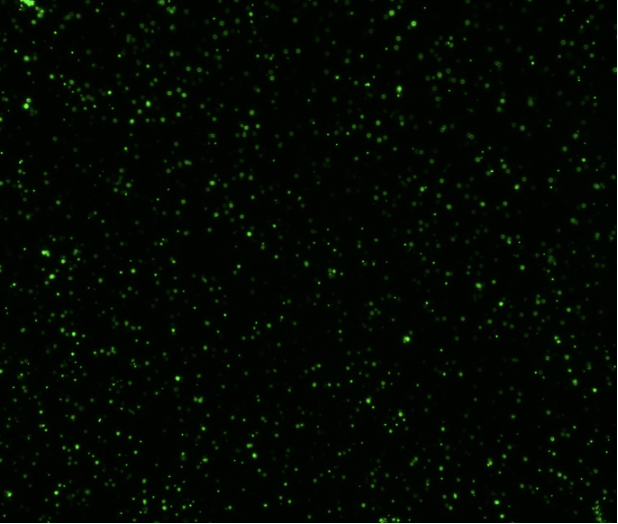
Visualization of bacteria within newt poop. Each green dot shows living bacteria within a single drop of newt feces.
Over the course of my PhD I will be exploring this question through both an observational and experimental study. In each case, I will first collect newt poop, then extract and sequence the bacterial DNA inside. I will then analyze these data for insights into how the community of bacteria living in the newt’s gut impacts the newt’s capacity to adapt.
In the observational study, I will collaborate with herpetologists (scientists studying amphibians and reptiles) across Europe to collect fecal samples (poop) from multiple newt species inhabiting a range of different environments. By analyzing these samples together, I hope to identify patterns in how the newt-host species, and environmental factors influence the community composition (which bacteria are present?) and functional profiles (and what can they do?) of the newt gut microbiome.
In the experimental study, I will bring newts into the laboratory where I can set and manipulate environmental conditions to better understand how varying climatic conditions, primarily temperature, impact the newt gut microbiome. The newts will then be acclimated to either a warm enclosure, at the higher end of temperatures these newts can tolerate in the wild, or a colder enclosure, more representative of what this species of newts favors in the wild.
Then, I will manipulate the gut microbiome of the cold-adapted newts, through a technique called fecal microbiota transplants (FMT). As the name suggests, FMT entails moving the microbiota of a donor-newt to a recipient-newt, to change the bacterial community of the recipient-newt to resemble that of the donor. Essentially, I mix a “smoothie” of saline and donor-newt poop from the warm-acclimated newts and feed it to the cold-acclimated recipient-newt.
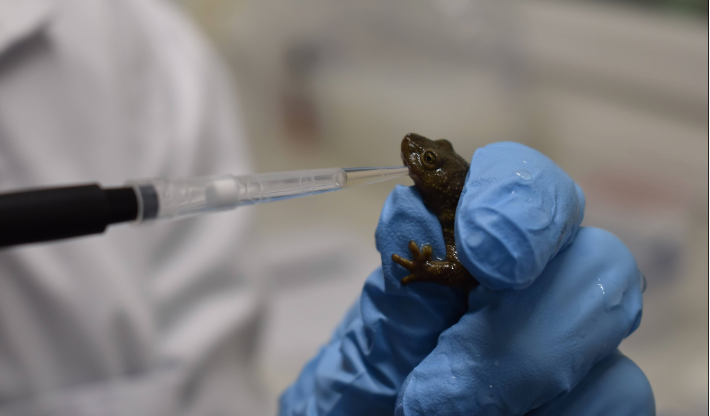
A newt receives a fecal microbiota transplant (FMT), a mix of saline and newt feces, during my captivity experiment in September 2025.
Following the transplants, I will expose the cold-acclimated newts to high temperatures, and measure the extent to which having the microbiota from warm-acclimated donors helps cold-acclimated newts react and acclimate to the new warmer conditions.
During the course of the entire experiment, I will test the newt’s physiological performance and behavior in addition to collecting fecal samples. Together, these integrated datasets may provide a more complete picture of how temperature impacts the newt holobiont.
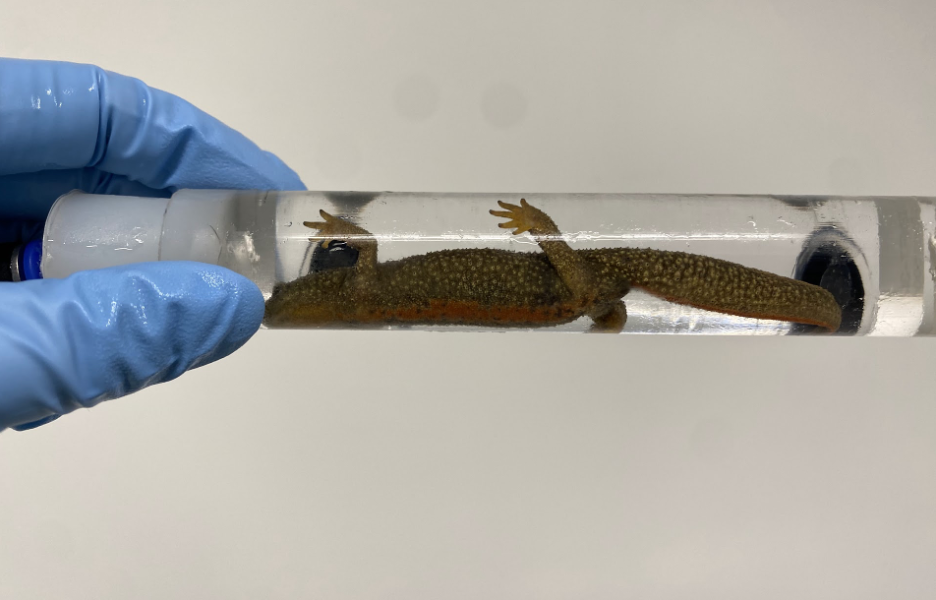
A newt inside a respirometry chamber, one of the physiological tests run to supplement the fecal samples collected during the captivity experiment.
With these two studies together, I hope to better understand if, and to what extent, newts’ associated microbiota confer extra adaptive capacity in the context of a warming world.
Beyond just helping scientists understand the role of microbiota in animal adaptations, this study may also have practical implications for species conservation and management. As amphibian populations rapidly decline, we need every tool available to help conserve these creatures. Perhaps these studies will help inform conservation programs to consider the microbiome when breeding animals in captivity, reintroducing them in the wild, and designing programs to protect these animals in their natural habitat.
