What if tiny microbes could help make agriculture more sustainable?
These invisible communities of bacteria, fungi, archaea, and other microorganisms live inside farm animals and may play an important role in the future of sustainable agriculture.
I’m Veronica, a PhD student at the Norwegian University of Life Sciences and part of the HoloGen Doctoral Network. My PhD focuses on understanding how diet, gut microbes, and the animal itself interact in pigs and cattle, and how these relationships may influence animal health, feed efficiency, and environmental sustainability.
When we think about sustainable agriculture, we often imagine greener farming practices, innovative technologies, or alternative feeds. However, one of the most fascinating systems linked to sustainability is hidden inside the animal gut: the microbiome.
This research explores how microbes interact with the animal host, shaping processes such as digestion, metabolism, and nutrient utilization. By better understanding these complex interactions, we may eventually develop feeding strategies that improve productivity while reducing environmental impact.
The project mainly focuses on pigs and cattle, two of the world’s most important livestock species. The broader goal is to contribute to more sustainable animal production systems that support both efficiency and animal well-being.
The tiny organisms that shape animal health
Inside the digestive system of every animal lives an enormous community of microorganisms called the gut microbiome. This includes bacteria, fungi, archaea, and protozoa. Even though they are microscopic, they play essential roles in digestion, immunity, metabolism, and overall health.
You can think of the microbiome as a hidden ecosystem living inside the animal. These microbes help break down food, produce important compounds, and even communicate with the animal’s body in ways scientists are still trying to fully understand.
For example, in cattle, microbes inside the rumen — a large stomach chamber that works like a fermentation tank — allow cows to digest plant material that humans cannot eat. Cows are ruminants, which means they have a stomach with several chambers, and the rumen is the first one food enters. Inside, billions of microbes break down tough plant fibers before the cow’s own digestive system gets involved. Without microbes, cows simply could not turn grass into energy.
In pigs, gut microbes influence how efficiently animals use nutrients from feed. This matters because feed production is one of the largest economic and environmental costs in livestock farming.
What fascinates me most is that these microbial communities are not random. Diet can change them. Genetics can shape them. And small changes in the microbiome may influence how animals grow, respond to feed, or even produce methane emissions.
Why this matters for sustainability
One of the biggest challenges in agriculture today is producing enough food for a growing global population while reducing environmental pressure.
In livestock systems, this means improving feed efficiency, helping animals get more nutritional value from the same amount of feed. Better efficiency can reduce waste, lower costs, and decrease pollution linked to agriculture.
Protein, for example, is one of the most expensive parts of animal feed, and not all of it is fully absorbed by the animal. The unused portion can end up contributing to nitrogen pollution in the environment.
If we understand how gut microbes help process nutrients, we may eventually design feeding strategies that are both more efficient and more environmentally friendly.
In cattle, another important issue is methane production. Methane is a greenhouse gas that traps a lot more heat than carbon dioxide, making it a major driver of climate change in the short term. It is naturally produced during digestion in ruminants like cows. Some microbial communities are associated with higher methane emissions, while others appear linked to lower emissions and better feed conversion.
Understanding these relationships could help us develop smarter and more sustainable livestock systems in the future.
Looking at the whole system
One of the most exciting aspects of my PhD is the use of something called holo-omics.
The name may sound complicated, but the idea is intuitive: instead of studying only one part of a biological system, holo-omics combines many different layers of information to understand how everything interacts together.
For example, scientists can measure:
- which microbes are present,
- which genes are active,
- which proteins are produced,
- and which metabolites are circulating.
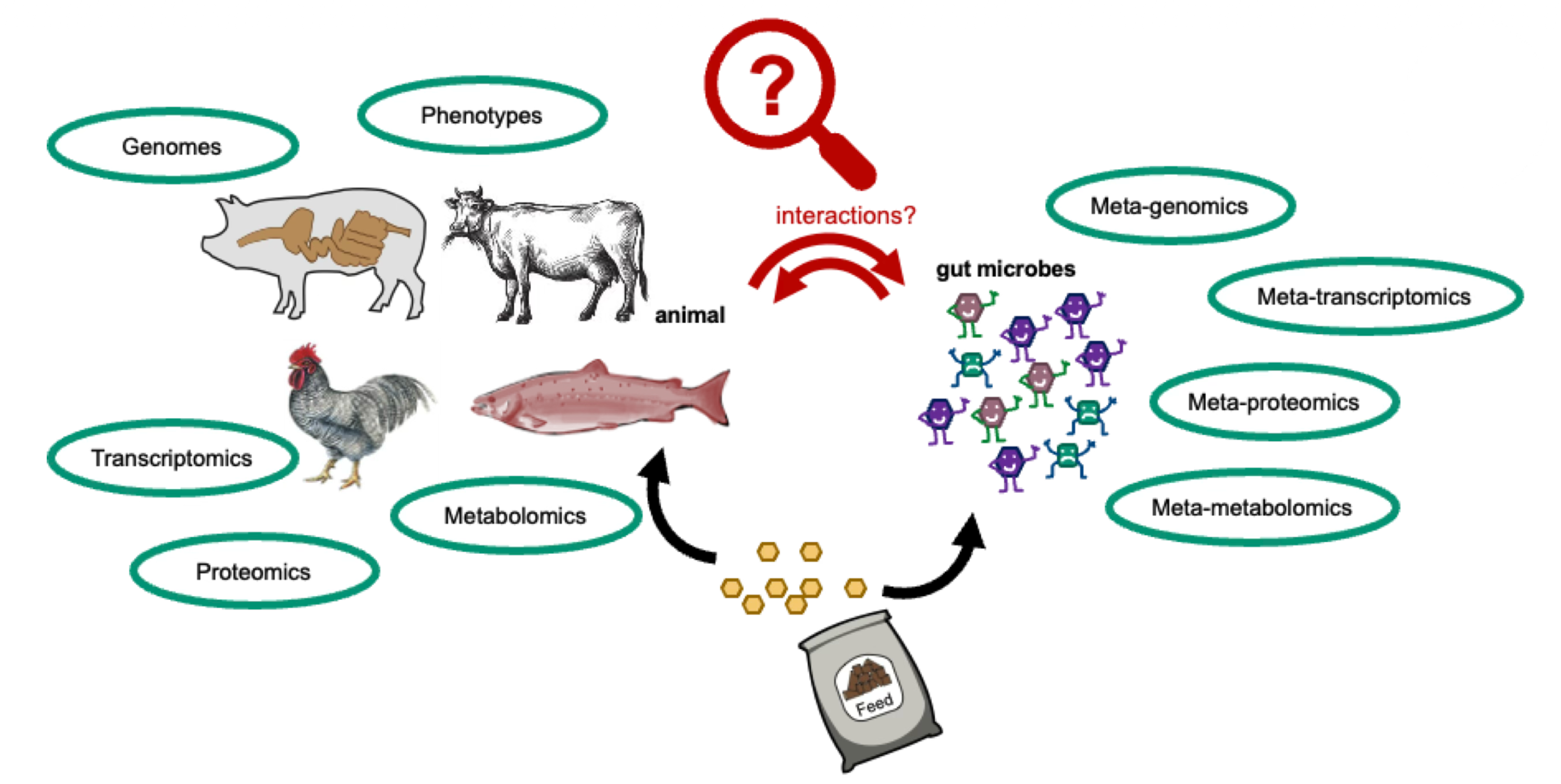
By integrating all these layers, we can begin to see how diet, microbes, and the animal influence one another. I like to think of it as moving from looking at isolated puzzle pieces to finally seeing parts of the full picture.
What excites me most
What I find most inspiring about this research is its interdisciplinary nature.
My project sits at the intersection of biology, data science, microbiology, animal science, and sustainability. Every dataset tells a different story, and each analysis can uncover unexpected connections.
I am especially excited by the possibility of discovering patterns that could contribute to more sustainable animal production in the future, whether through improved feed strategies, better understanding of animal health, or reduced environmental impact.
At the same time, I love that this work explores a world we rarely think about: the invisible microbial ecosystems that quietly shape life every day.
There is still so much we do not know about these systems. That uncertainty can be challenging, but it is also what makes research exciting.
Over the next few years, I hope my PhD will help uncover some of these hidden interactions and contribute, even in a small way, to building a more sustainable future for agriculture.
