Welcome — this blog is an invitation to explore a hidden world inside us: the microbes that travel, compete, and settle in our gut from the very beginning of life.
I’m Chujun, a PhD student from Hologen Group, studying in Professor Lindsay Hall’s Lab at University of Birmingham. In my research, I study how the early-life gut microbial communities form, change, and differ across the world. In this story, I will be your guide as we follow these tiny travellers from birth to a global scale — with a special focus on Bifidobacterium, one of the microbes that thrive in early life and help shape the gut environment.
Tiny Travellers in Our Gut
Human beings are never truly alone. Inside our gut lives a vast microscopic world made up of trillions of microbes, including bacteria, viruses, and fungi. Together, these tiny organisms form what scientists call the gut microbiome.
Although invisible, this hidden community quietly affects many parts of our daily lives. But don’t worry — many gut microbes are actually helpful partners. Some gut microbes help break down components of food that our own bodies cannot digest alone — for example, certain fibres found in fruits, vegetables, and grains. Others produce useful compounds and vitamins, or interact with the immune system as it learns to distinguish harmless visitors from dangerous invaders.
Scientists are also beginning to realise that the gut microbiome is not just a simple random collection of microbes. It is a living ecosystem that changes throughout our life, so closely connected to human health that it is sometimes described as a hidden “microbial organ” within the body. Like any ecosystem, the gut microbiome depends on balance. Antibiotics, changes in diet, new environments, or even how a baby is fed during infancy can all influence which microbes thrive inside the gut. Most of the time, these ecosystems adapt and remain healthy. However, when the balance of the microbiome changes too greatly, it can sometimes influence health and behaviour in unexpected ways. Therefore, just as we care for the health of our heart, lungs, or liver, maintaining a healthy balance within this hidden microbial world also be important for our overall well-being.
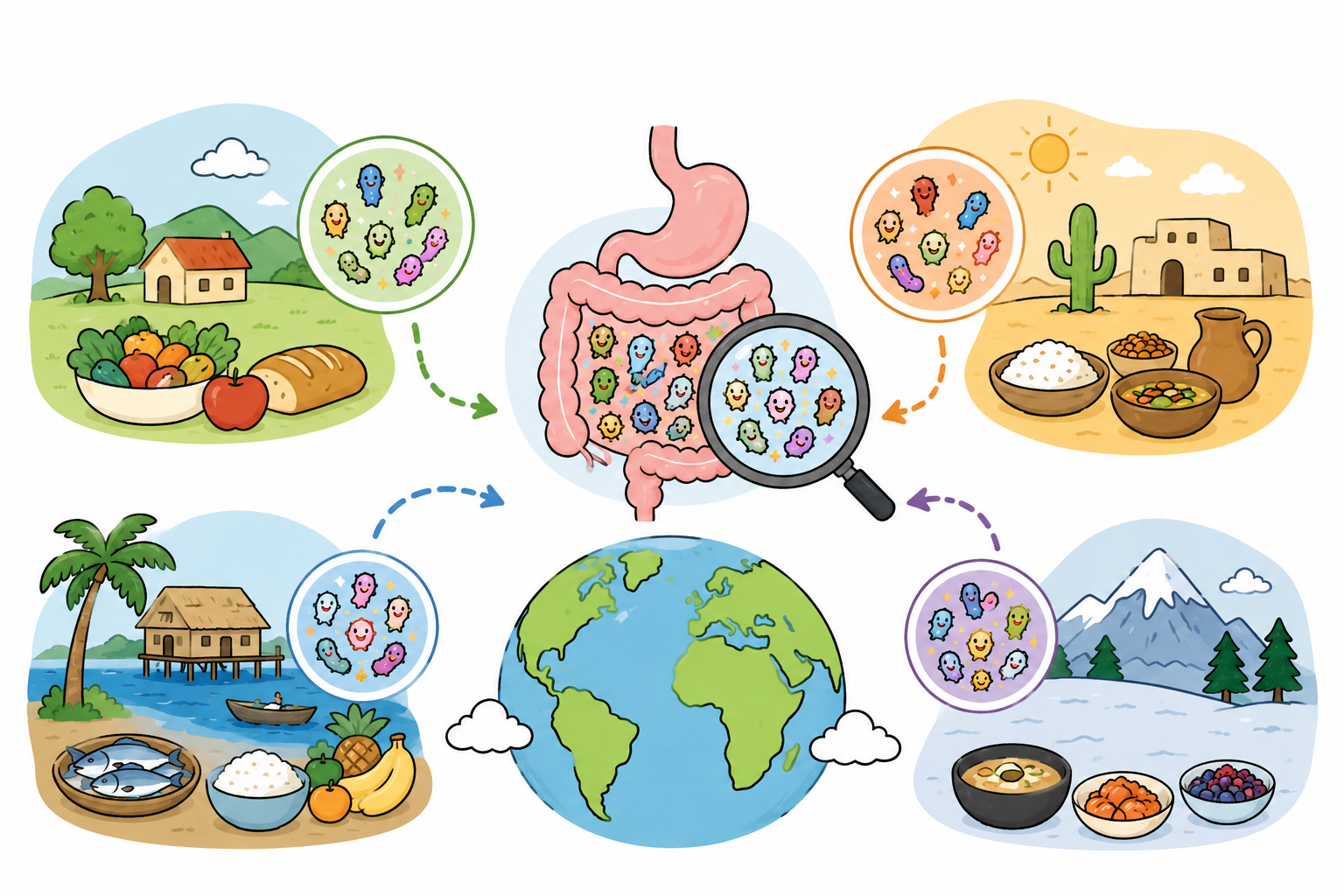
Also, the gut microbiome is not exactly the same in every person. As people live in different environments around the world, these microbial ecosystems can develop in different ways.
If you travel around the world, you might notice how food, climate, and culture change from place to place. Less obvious, however, is that these differences also influence the microscopic ecosystems living inside us. Over time, different environments can subtly influence which microbes thrive, compete, or persist inside the gut.
And those differences start very early in life.
A Story That Start at Birth
Imagine a newborn baby entering the world. Although everything appears quiet from the outside, another hidden process has already begun inside the gut. Millions of microbes are starting to arrive and interact, gradually forming a tiny new ecosystem.
During the first years of life, this invisible community changes rapidly, eventually developing into one of the most complex microbial ecosystems in the human body.
How Is the Early-Life Gut Microbiome Established?
The early-life gut microbiome does not appear fully formed all at once. Instead, it develops step by step. The first microbes arrive during birth and through close contact with parents and caregivers. And then they are shaped by feeding, environment, and daily exposures. Some microbes successfully settle and grow, while others disappear as conditions inside the gut continue to change. As infants transition from milk to solid foods, the gut environment changes again. New nutrients create new ecological opportunities, allowing different microbes to thrive and reshape the developing microbial community. Over the first few years of life, this hidden ecosystem becomes increasingly complex and stable. By around two to three years of age, the gut microbiome begins to resemble a more adult-like community. Even so, the process does not unfold in exactly the same way for every child. Small differences in diet, lifestyle, environment, and daily experiences can shape distinct microbial communities over time.
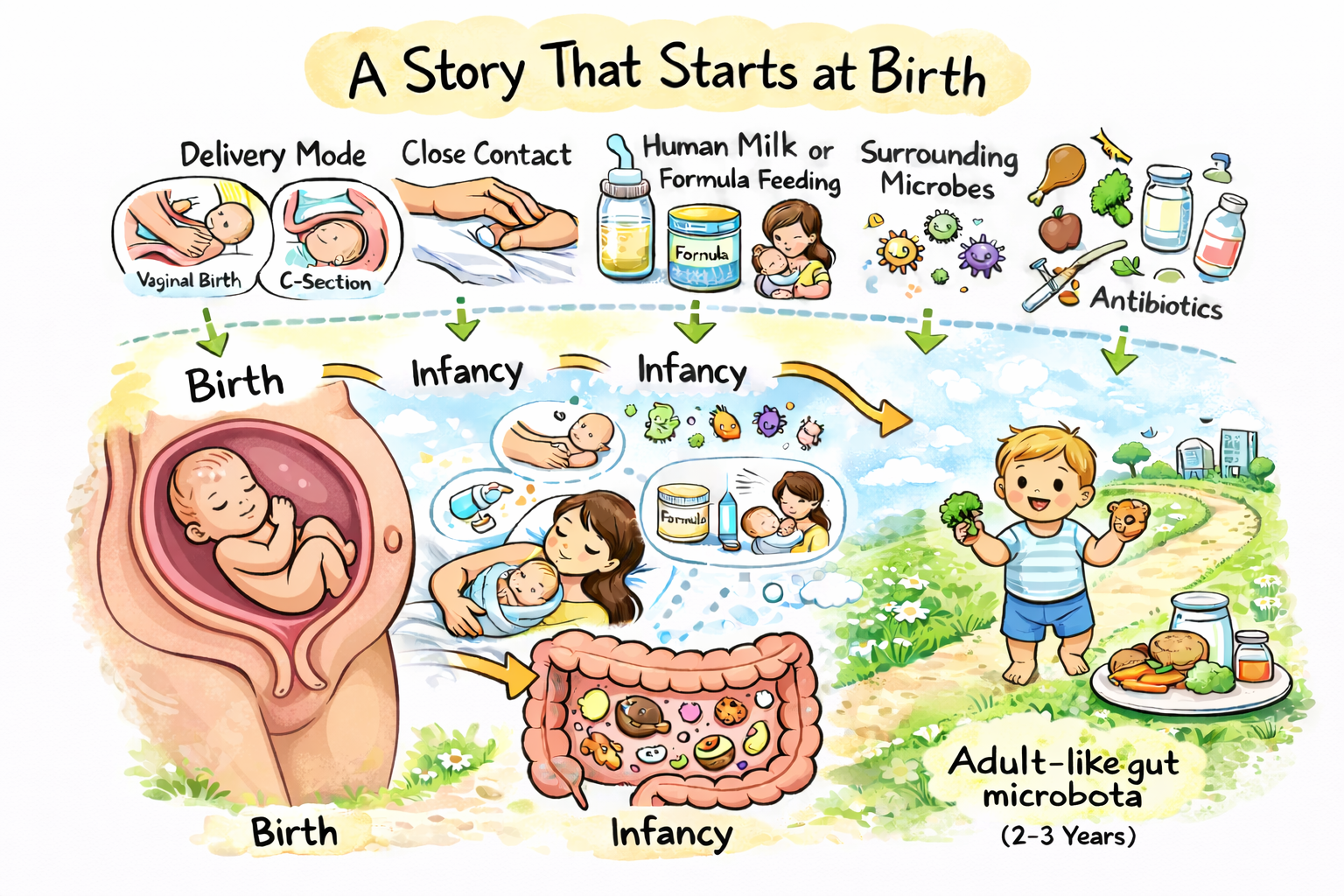
This early stage is especially important because the gut ecosystem is still developing. Scientists believe that changes during this period may influence health later in life, including the risk of allergies and some immune-related diseases.
A Silent War for a Living Space
Which Microbes Successfully Establish in the Infant Gut?
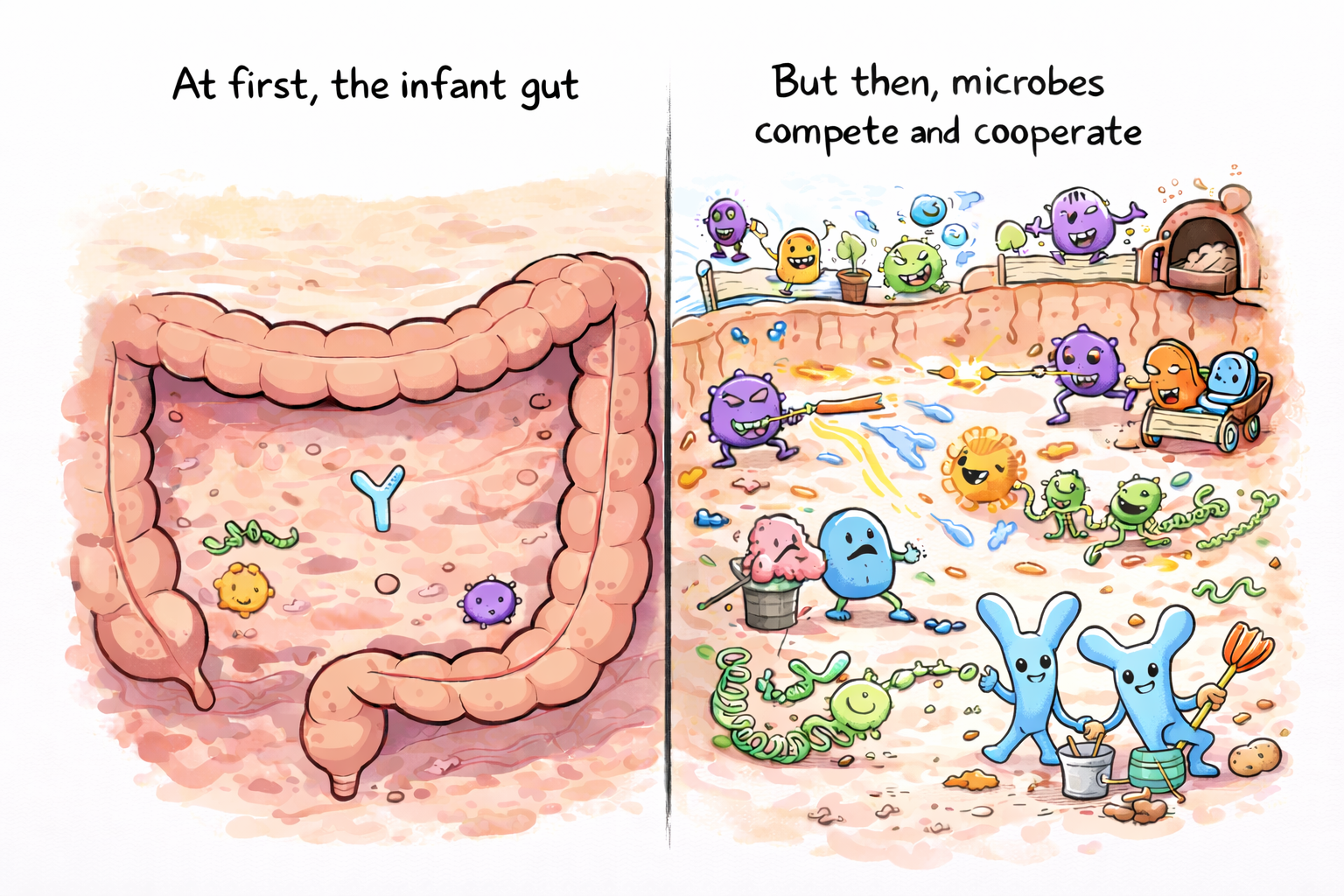
At birth, the infant gut is not yet a crowded ecosystem, but rather a nearly empty environment — with few established microbes and many unoccupied niches. It is more like a newly opened landscape, where the first arrivals have a crucial advantage: they can settle, grow, and shape the conditions for those that come later. Over time, different microbes arrive at different stages of early life. Some come early during birth, others come later through feeding, touch, and the surrounding environment.
But not all of them can stay. They compete.
They compete for limited resources — nutrients and space in the gut. They compete in different ways. Some release chemicals into their surroundings to slow down or inhibit others, while some rely on direct contact — interacting with neighbouring microbes to block their growth or push them out. They also follow different ecological strategies. Some microbes are fast colonisers, quickly taking advantage of available resources. Others are specialists, waiting for specific conditions — like the introduction of solid food — to expand.
But competition is only part of the story — some microbes also depend on each other. One microbe may break down complex substrates, such as dietary fibre or other complex carbohydrates, into simpler compounds that can be used by other microbes, creating chains of shared resources within the gut. At the same time, external disturbances, such as antibiotics, can suddenly change the microbial balance — resetting the battlefield and giving new players a chance to establish.
Over time, this constant competition, cooperation, and replacement gradually shapes a more stable microbial community. Some microbes establish long-term residence, forming the backbone of the gut ecosystem. Others appear only briefly and disappear. This is not a peaceful process. It is a dynamic, ongoing reshaping of the ecosystem — a silent war where the winners are not always the strongest, but the ones best adapted to the gut environment.
A Main Player: Bifidobacterium
In this silent war, one group consistently stands out: Bifidobacterium. These bacteria are among the earliest colonisers of the infant gut and often thrive during the first months of life.
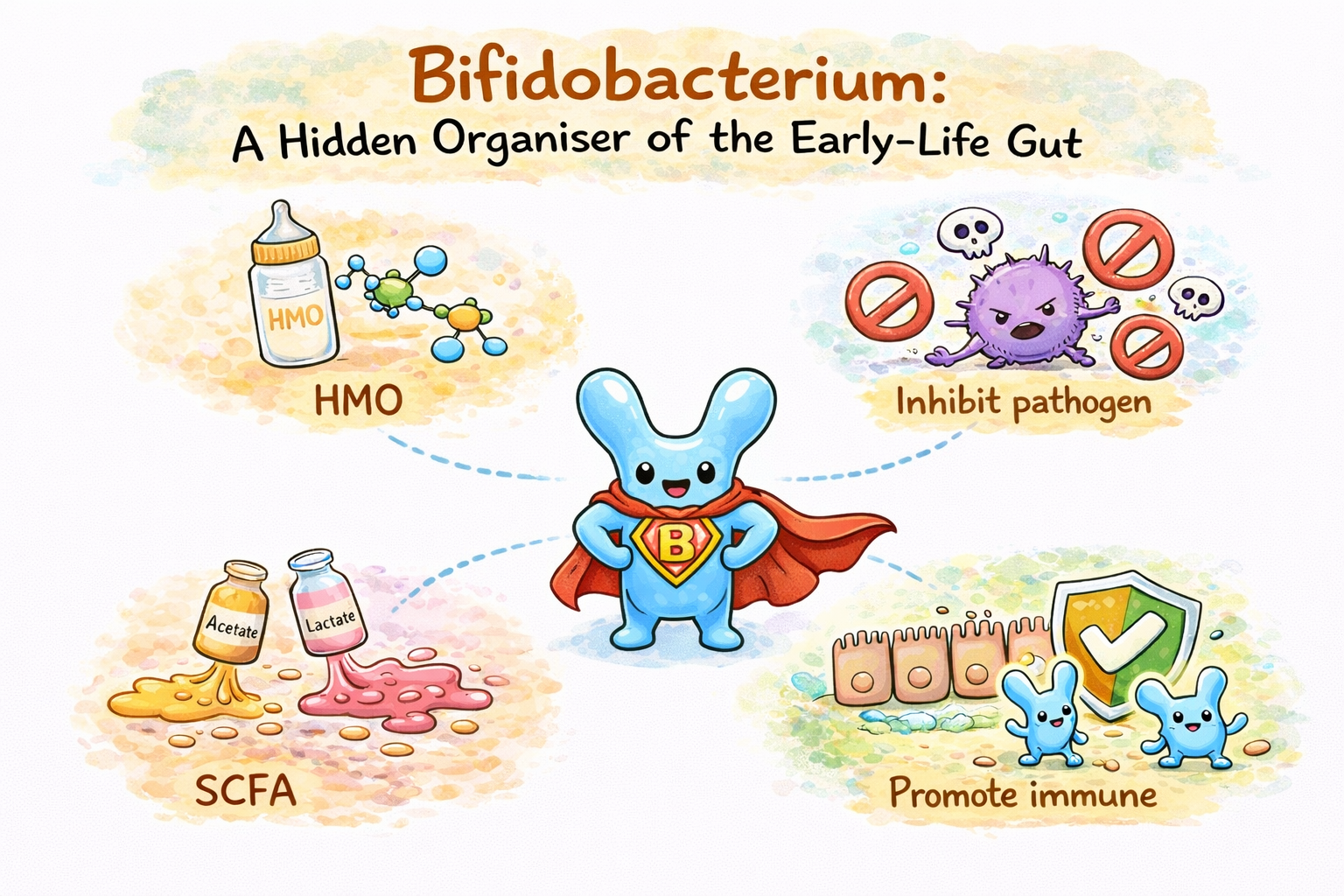
Their success is not by chance. The infant gut is a very specific environment, and Bifidobacterium are particularly well adapted to it. Specifically, in human milk feeding infants, they are able to use human milk oligosaccharides (HMOs) — complex carbohydrates that many other microbes cannot directly digest. This gives them a strong advantage when resources are limited.
But their role goes beyond competition. By breaking down HMO, they produce small metabolites such as acetate and lactate. These simpler compounds can then be further utilised by other microbes. These compounds can also lower gut pH — making the environment more acidic — which can inhibit the growth of potential pathogens and support the development of the gut barrier and immune system. In this way, Bifidobacterium are not only successful competitors, but also key organisers of the early-life microbial community.
However, their dominance is not universal. Which types of Bifidobacterium are present, and how abundant they are, can vary widely depending on early-life conditions — including feeding practices, environmental exposures, and broader ecological contexts.
The Bifidobacterium Identity Atlas
To understand how different environments shape which Bifidobacterium thrive, we need a way to tell these bacteria apart — and to understand their functional traits (characteristics) that give them an advantage in different environments.
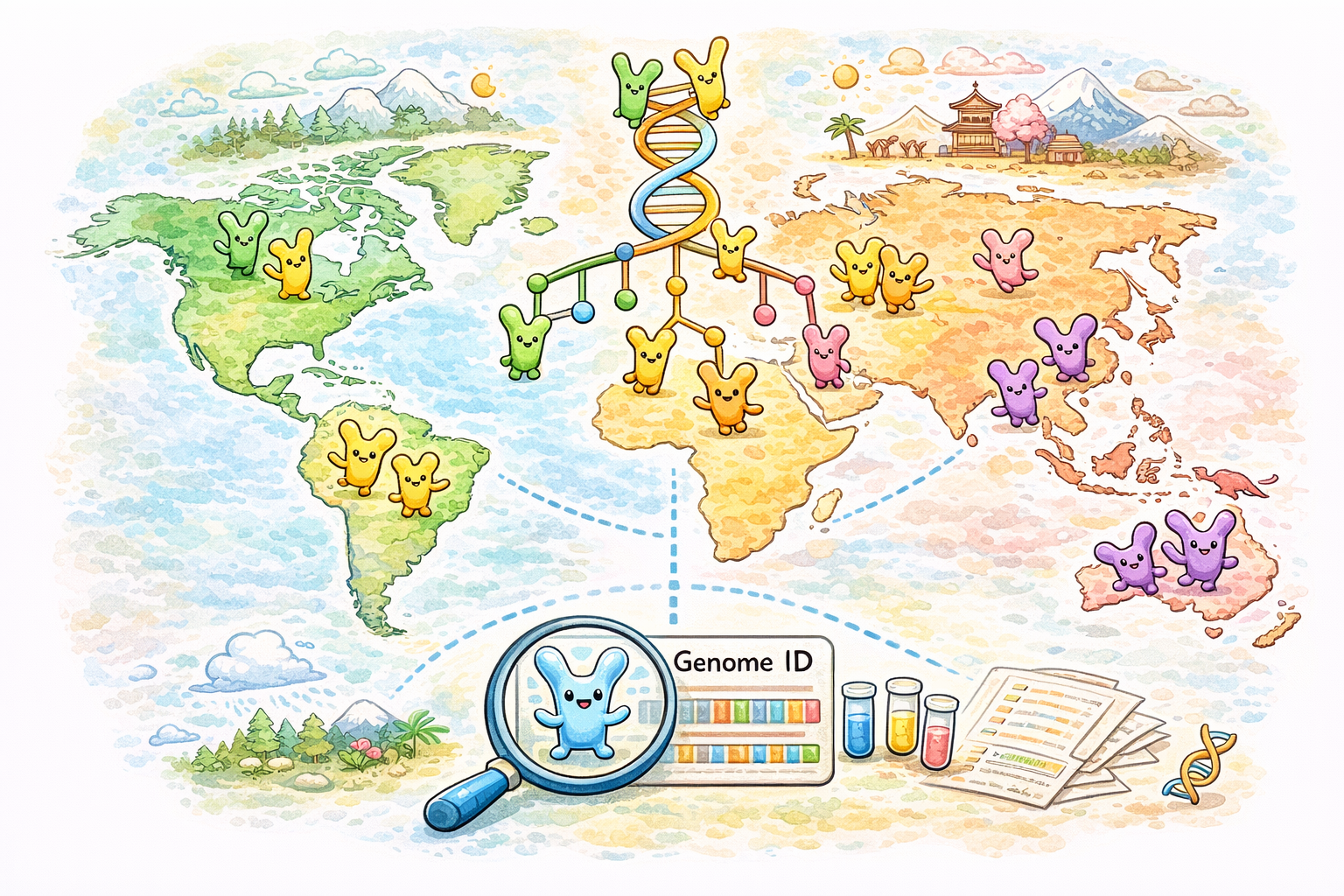
This is where genomes become important. A genome — the complete set of DNA in a microbe — can be thought of as an identity card, containing the information that distinguishes one Bifidobacterium from another. Even very closely related microbes — even those that seem almost identical — still carry small genetic differences that set them apart.
By comparing these genomic “IDs” across many samples, we can begin to reconstruct the relationships between them. This allows us to build something like a family tree, showing how different Bifidobacterium are related — which ones share common ancestors and which ones have diverged over time. It also lets us compare babies from different parts of the world, where some types of Bifidobacterium are more common in certain places than in others.
In this way, genomes allow us to move beyond simply asking which microbes are present, to understanding how they are connected, how they vary, and how they have adapted to different environments. This also opens the door to a more applied question: whether specific Bifidobacterium types are better suited to infants in different geographic regions, and all this knowledge could be used to design more targeted, region-specific microbial interventions.
The Journey Continues
These are the questions I will explore in my PhD research — using genomic data to distinguish different Bifidobacterium, trace how they are related, and understand why certain types thrive in different parts of the world.
Thank you for joining me on this journey into the hidden world of our gut. There is still so much to discover, and this is only the beginning.
See you next time!
Written by Chujun Zhang, who is on the journey to understand the tiny travellers in our gut. Illustrations by Chujun Zhang, created in collaboration with her AI assistance “ChanglinJ”. Guided by Professor Lindsay Hall, whose insights shaped this journey and made it possible.
